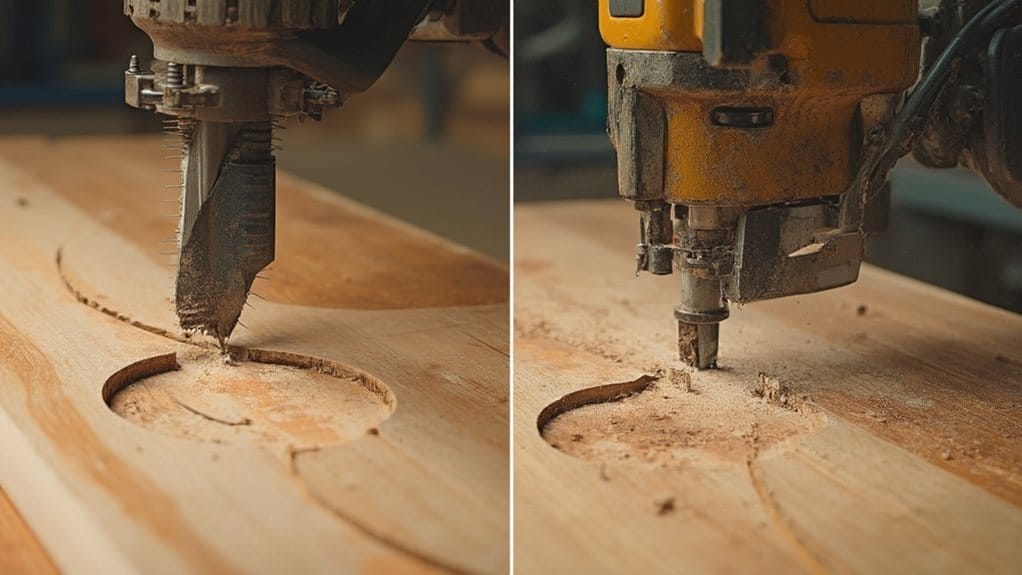
When choosing between a scroll saw and jigsaw, you'll need to evaluate your project requirements. A scroll saw is a stationary power tool that excels at intricate, detailed cuts up to 2 inches thick, making it perfect for delicate fretwork and precision projects. In contrast, you'll find a jigsaw offers portability and versatility, handling cuts up to 3 inches deep across various materials like wood, metal, and ceramic. While scroll saws provide better accuracy with their table-mounted design and thin blades, jigsaws give you the freedom to make both straight and curved cuts on the go. Let's explore which saw best matches your woodworking needs.
Understanding Key Design Features
A fundamental grasp of design features sets scroll saws and jigsaws apart in significant ways. When you're working with a scroll saw, you'll find it's a stationary, table-mounted tool that allows you to manipulate the material while the blade moves in a non-linear motion. This design advantage offers superior precision for intricate cuts compared to jigsaws, which you'll need to move across the material yourself.
The operational efficiency of scroll saws becomes evident in their workspace setup. You won't need sawhorses or clamps, since the built-in table provides a stable working surface. The tool's design lets you sit comfortably while working, reducing fatigue during lengthy projects. You'll also benefit from features like adjustable tables that can tilt for bevel cuts and user-friendly controls that enhance your cutting experience. Additionally, choosing the right blade for your jigsaw can significantly improve your cutting precision and overall results.
In contrast, when you're using a jigsaw, you'll need to move the handheld tool over your workpiece, often in a stooped position. While jigsaws offer mobility, they can't match the controlled environment and cutting precision that a scroll saw's stationary design provides, especially for detailed work.
Blade Differences That Matter
Physical differences between scroll saw and jigsaw blades directly impact their cutting capabilities. While jigsaw blades are wider and straight with T or U shanks, scroll saw blades are remarkably thinner, measuring up to 1/8-inch, making them ideal for intricate work. You'll find that blade compatibility varies considerably between these tools, with jigsaws offering options for wood, metal, and plastic, while scroll saws excel in detailed woodworking.
The way these blades attach to their respective tools affects cutting precision dramatically. Scroll saw blades benefit from even tension between two moving arms, reducing the risk of bending and allowing for more controlled cuts. In contrast, jigsaw blades, secured only at the top with a spring return mechanism, can be more prone to damage during use.
You'll notice a considerable difference in cutting direction capabilities. Jigsaws cut only on the downstroke, limiting their maneuverability. However, scroll saw blades can cut in both directions and offer 360-degree cutting capability, perfect for intricate fretwork. When selecting blades, remember that tooth count increases with material hardness, ensuring cleaner cuts and better results in your projects. Additionally, understanding blade types and applications can further enhance your choice of saw for specific tasks.
Power and Cutting Performance
Distinct power capabilities set scroll saws and jigsaws apart in fundamental ways. Scroll saws operate with motors ranging from 0.6 to 1.5 amps, focusing on precision rather than raw power. You'll find their motor efficiency is optimized for maintaining constant blade tension, which ensures accurate cuts in thinner materials.
In contrast, jigsaws offer greater versatility in cutting speed and power delivery. You can adjust their speed settings to tackle various materials, from wood to metal and ceramic. While scroll saws are limited to about 2 inches in cutting depth, you'll be able to cut up to 3 inches deep with a jigsaw using the right blade.
Your cutting performance needs will largely determine which tool serves you better. If you're working on intricate designs in thin wood, a scroll saw's stationary position and controlled power delivery will give you superior results. However, if you need to handle thicker materials or require portability, a jigsaw's higher cutting speed and power make it the more practical choice. The jigsaw's versatility in power adjustment also means you'll have better control over different cutting applications.
Safety Considerations When Operating
Several critical safety measures set these tools apart when it comes to operation. With jigsaws, electrical safety is paramount – you'll need to operate them on an RCB circuit and ensure they're never used in wet conditions. Scroll saws require proper mounting to a workbench, which enhances both stability and electrical safety through proper grounding.
For cut prevention, both tools demand different approaches. When using a scroll saw, you'll work with both hands on either side of the cutting line, keeping your fingers well away from the blade path. With a jigsaw, you must maintain firm control of the tool while ensuring your free hand stays clear of the cutting area. Never reach underneath the workpiece while operating either saw.
Proper PPE is essential for both tools – you'll need impact-resistant eyewear, a dust mask, and appropriate footwear. Keep your work area well-lit and free from obstacles. Before starting any cut, ensure your workpiece is properly secured using clamps. Remember to power down completely and wait for blade stoppage before making any adjustments or moving materials, regardless of which saw you're using.
Choosing Your Perfect Saw
Now that you understand the safety requirements for both tools, selecting between a scroll saw and jigsaw comes down to your specific project needs and working style. Your choice should primarily focus on project types and material selection that you'll be working with most frequently.
Choose a scroll saw if you're planning to work on intricate designs, detailed fretwork, or delicate wooden crafts. It's your best option when precision is essential and you're working with thin materials up to 2 inches thick. You'll need dedicated workshop space since it's a stationary tool, but the accuracy you'll achieve makes it worth the commitment for detailed projects.
Opt for a jigsaw if you need versatility and portability in your work. It's ideal if you're tackling diverse project types involving different materials like wood, metal, or ceramic, and need to make cuts up to 4 inches deep. You'll appreciate its flexibility for both straight and curved cuts, plus its ability to make plunge cuts. The jigsaw's handheld design and simpler blade changes make it perfect if you're working in various locations or need a tool that's easy to transport. Additionally, consider variable speed features which enhance control and precision during your cuts.
Conclusion
You'll find both saws valuable in your workshop, but they serve distinct purposes. Choose a scroll saw when you need intricate, detailed cuts and patterns in thinner materials. Opt for a jigsaw when you want portable, freehand cutting in various materials and thicknesses. Consider your primary projects, budget, and workspace before deciding – or invest in both tools to maximize your woodworking capabilities.