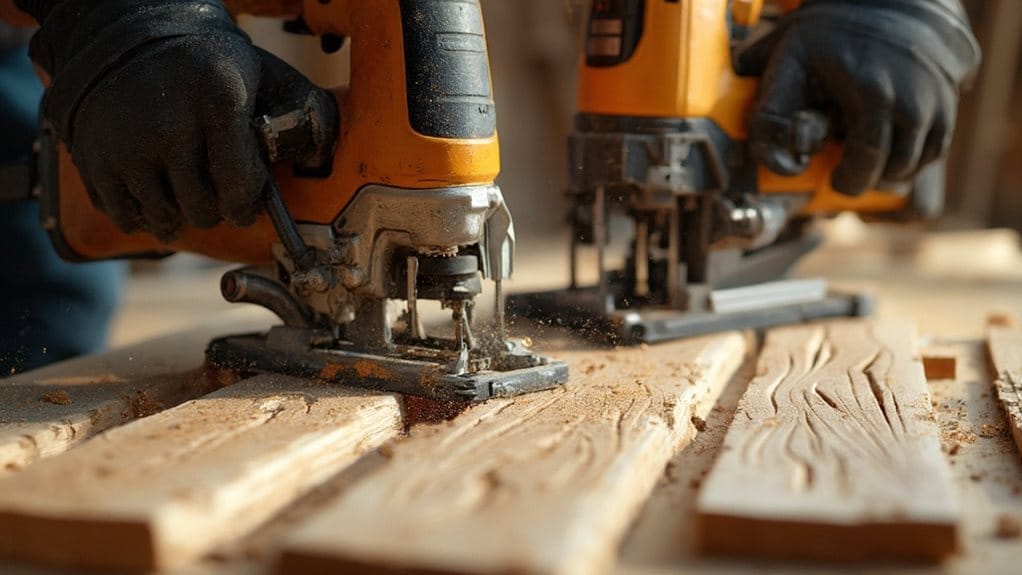
When choosing between a scroll saw and jigsaw, consider your project's specific needs. You'll want a scroll saw for intricate, detailed work like wooden portraits and puzzles, since it offers precise cuts in materials up to 1/2" thick. If you're tackling general construction tasks or need portability, a jigsaw is your best bet – it handles thicker materials and allows for plunge cuts without starter holes. Beginners often start with a jigsaw's straightforward operation, while scroll saws require more practice and patience. Your workspace setup and skill level will also influence which tool suits your needs, and there's much more to explore about each option's unique capabilities.
Key Differences at a Glance
The power-tool showdown between scroll saws and jigsaws reveals fundamental differences in their design, operation, and capabilities. While scroll saws are benchtop machines requiring dedicated workspace, jigsaws offer portable operation that you can take anywhere. You'll find that scroll saws demand a seated position, making them accessible for users with mobility concerns, while jigsaws typically require standing and bending over your work.
When it comes to cutting precision, scroll saws excel at intricate detailwork, particularly in projects like intarsia and marquetry. Their thin blades, secured at both ends, allow for exceptionally precise cuts. In contrast, tool versatility is the jigsaw's strong suit. You can use it to cut through materials up to 4 inches thick and tackle a wide range of cutting patterns, making it suitable for various materials, including wood, plastic, and metal.
The tools also differ considerably in their operation. With a scroll saw, you'll move the material around a fixed blade, while a jigsaw requires you to guide the tool over stationary material. Safety considerations vary too – scroll saws require extra caution due to direct blade exposure, but jigsaws offer more protection with their guided sole designs and blade positioning.
Understanding the Cutting Mechanism
Masterful engineering sets scroll saws and jigsaws apart in their cutting mechanisms. While scroll saws utilize a parallel arm system that creates precise up-and-down blade movement, jigsaws employ a spring-loaded clamp with orbital action that produces circular motions during operation.
The scroll saw's design focuses on blade stability through its parallel link system, where two arms form a parallelogram with the blade and back link. This mechanism, driven by a variable speed motor with a counterweight, minimizes lateral blade movement and enhances cutting precision. You'll notice the workpiece moves around the fixed blade while maintaining constant contact with the work table.
In contrast, you'll control a jigsaw by moving it over your workpiece as the blade oscillates. The jigsaw's blade protrudes from the machine's top, and you'll guide it using the sole plate for stability. While both tools offer variable speed control, their fundamental cutting actions differ considerably. With a scroll saw, you'll need to drill starter holes for interior cuts, whereas a jigsaw lets you plunge directly into the material. Understanding these mechanical differences will help you choose the right tool for your specific cutting needs. Additionally, recognizing the blade types and applications is crucial for optimizing your projects.
Blade Types and Features
Selecting the right blade dramatically influences how both scroll saws and jigsaws perform their distinct cutting actions. Understanding blade characteristics is essential for achieving peak cutting precision with either tool.
Scroll saws offer several specialized blade types. Standard tooth blades handle most general tasks, while skip tooth blades provide better waste clearance and visibility, making them ideal for beginners. Double tooth blades excel at reducing chip-out in hardwoods and dense materials. For unique cutting needs, specialty blades like spiral and crown tooth options offer solutions for irregular patterns and smoother finishes.
Jigsaws typically use general-purpose blades that work with various materials, though you'll find specialized options for metal cutting. You can even enhance your jigsaw's versatility with file attachments for detailed work. What's particularly convenient is that both tools can often use plain end 5" blades, allowing for some interchangeability between machines. Additionally, features such as variable speed control enable you to customize your jigsaw's cutting power, enhancing its effectiveness for different blade types and materials.
When selecting blades, consider tooth count and spacing: higher counts deliver finer cuts, while lower counts work better for rougher cuts. This flexibility in blade options lets you match the right blade to your specific project requirements.
Material Handling Capabilities
Both tools excel at different material challenges, but their distinct handling capabilities set them apart in meaningful ways. The scroll saw offers superior cutting accuracy for intricate designs, especially in materials up to 1/2" thick. You'll find it particularly effective when working with wood, Corian, acrylic, and even soft metals up to 1/8" thick, though you'll need specific blades for ideal material compatibility.
The jigsaw, while less precise, compensates with versatility and ease of use. You can tackle thicker materials and make rougher cuts without requiring extensive expertise. It's your go-to tool for larger projects where fine detail isn't vital.
When it comes to internal cuts, both tools can handle them, but differently. With a scroll saw, you'll need to drill a starter hole and thread the blade through, while a jigsaw allows you to plunge directly into the material. The scroll saw requires you to work from a seated position, offering better control for detailed work. In contrast, the jigsaw's portability means you can work in various positions, though you'll sacrifice some precision in exchange for this flexibility.
Project Applications
These distinct handling capabilities naturally point to different ideal project applications. If you're working on design intricacies like wooden portraits, decorative plaques, or intricate puzzles, you'll find a scroll saw's precision invaluable. Its ability to make detailed cuts and handle complex patterns makes it the perfect tool for craft projects involving delicate letter carving and fretwork.
On the other hand, a jigsaw's project suitability shines in general construction and remodeling tasks. You'll appreciate its versatility when tackling demolition work, cutting pipes, or making broader cuts in various materials. While it can handle curved lines, it's better suited for less intricate designs where speed matters more than minute detail.
Consider your working style when choosing between these tools. If you prefer working while seated and need precise control over cutting speed, a scroll saw offers these advantages. However, if you need portability and the ability to work in different locations, a jigsaw's mobility makes it the better choice. For beginners, the jigsaw's straightforward operation might be more appealing, though it requires extra caution due to its exposed blade. Additionally, understanding tool selection can significantly enhance your cutting efficiency and project outcomes.
Skill Level Requirements
A significant difference between scroll saws and jigsaws lies in their required skill levels. If you're just starting with power tools, you'll find the jigsaw much more approachable. It's designed for straightforward operation, allowing you to make cuts by simply guiding the tool along your marked line. Even while a beginner, you can achieve satisfactory results with minimal practice, making it an excellent choice for basic woodworking projects.
The scroll saw, however, demands more dedication to master. While beginner tips can help you get started, you'll need to invest time learning proper material handling and blade management. You'll sit at the scroll saw, guiding your workpiece through a fixed blade, which requires steady hands and careful control. Advanced techniques like intricate fretwork and detailed interior cuts won't come immediately – they require patience and practice.
Your choice between these tools should align with your current skill level and project goals. If you need to make general cuts quickly, the jigsaw's gentle learning curve makes it ideal. But if you're willing to develop precise cutting skills for detailed work, the scroll saw's capabilities will reward your dedication.
Portability and Workspace Setup
While mastering these tools requires different skill levels, their portability and workspace needs also play a major role in your decision-making process. When it comes to tool convenience, the jigsaw clearly stands out like the more portable option. You'll find it easy to carry between work sites, and you won't need a dedicated workspace to make your cuts. All you'll need is a flat surface and some clamps to secure your workpiece.
The scroll saw, however, demands a more permanent setup. You'll need to designate a specific area in your workshop, complete with a stable table or stand. While this limits workspace flexibility, it offers significant advantages for precise cutting. The built-in table provides consistent support for your workpiece, and you won't have to juggle managing both the tool and material simultaneously. You'll also benefit from features like dust collection and adjustable blade tension, which aren't available with a jigsaw. Additionally, investing in proper tool organization can enhance your workspace efficiency and make accessing both tools easier.
If you're planning to work in various locations or have limited space, a jigsaw might be your best choice. But if you can dedicate a permanent workspace, a scroll saw's stability and support features could prove invaluable for your projects.
Conclusion
Your choice between a scroll saw and jigsaw depends on your specific project needs. If you're looking for intricate, detailed cuts and have a dedicated workspace, go with a scroll saw. If you need versatility and portability for rough cuts or curved lines in various materials, choose a jigsaw. Consider your skill level, workspace, and project requirements to make the best decision for your woodworking goals.